

In 2016, the internet seemed untouchable. Netflix streamed without pause, Twitter and Reddit buzzed with constant chatter, and even Minecraft servers ran like bustling digital playgrounds. Then, one October afternoon, that illusion shattered. Half the internet went dark.
The world scrambled for answers. Surely this had to be the work of a hostile nation state or perhaps a billion dollar cybercrime syndicate. But the truth was stranger, almost absurd. The culprits were not elite spies or shadowy organizations. They were three young men barely out of high school. Paras Jha, a computer science student at Rutgers University in New Jersey, Josiah White from Washington, Pennsylvania, and Dalton Norman from Louisiana began their journey with nothing more than a desire to win at Minecraft.
What started as a tool to knock rival game servers offline mutated into something much larger. The trio wrote code that could take over poorly secured devices, the cheap webcams, DVRs, and home routers that were flooding into households at the time. The malware, which they named Mirai, spread like wildfire, silently conscripting tens of thousands of “smart” devices into a botnet army.
When they turned this army loose, the results were catastrophic. The Mirai botnet launched one of the largest Distributed Denial of Service attacks in history, overwhelming the internet infrastructure company Dyn. With Dyn crippled, huge swaths of the web including Twitter, Netflix, GitHub, Reddit, and countless other sites became unreachable for hours. Ordinary college students, chasing petty dominance in a video game, had revealed just how fragile the backbone of the internet really was.
Mirai was more than a stunt gone wrong. It was a wake up call. It showed the world that the security of our digital future did not only depend on billion dollar firewalls or elite agencies but also on the millions of small, cheap devices sitting unprotected in homes. It was proof that sometimes the greatest threats are born not in war rooms or boardrooms but in dorm rooms.
What Really Happened
Mirai wasn’t some mythical “super virus” that magically crippled the web. It was simple, clever, and brutally effective.
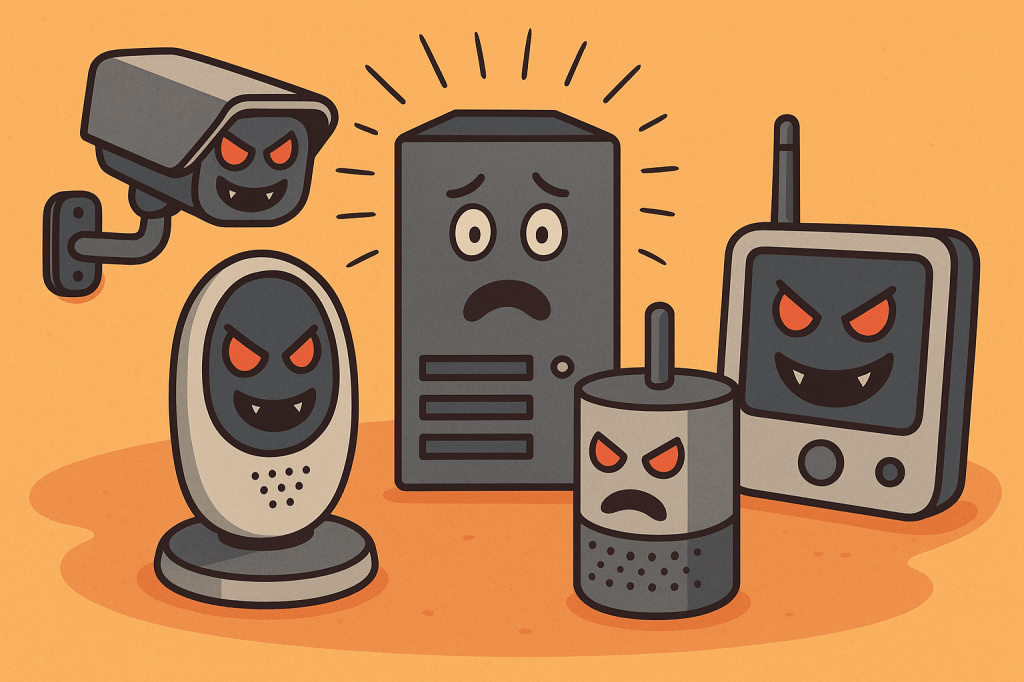
At its core, Mirai was built to do one thing: hunt. The code endlessly scanned the internet for vulnerable Internet of Things devices — security cameras, DVRs, baby monitors, and the cheap home routers that had begun filling living rooms and offices. These devices were designed for convenience, not security, and most were shipped with default usernames and passwords like admin/admin or root/12345. Almost nobody bothered to change them, and that single oversight became Mirai’s greatest weapon.
Whenever Mirai discovered one of these weakly protected devices, it would quietly log in, drop its malware, and claim the device as part of its growing army. To the owner, the device kept working as if nothing had changed. The baby monitor still streamed, the DVR still recorded, the router still provided Wi-Fi. But behind the scenes, each infected device became a bot waiting for orders from a central Command and Control server.
When the operators issued a command, tens of thousands of compromised devices would wake up and act in unison. They would unleash an ocean of junk traffic — endless floods of packets hammering a single target until it crumbled under the pressure. This was a Distributed Denial of Service attack, but on a scale the world had never witnessed before.
The first demonstrations were terrifying. In September 2016, Mirai was used against the website of security journalist Brian Krebs, who had exposed the underground world of DDoS-for-hire services. The attack peaked at an astonishing 620 gigabits per second of traffic, the largest ever recorded at the time. The flood was so overwhelming that Akamai, the massive security company protecting Krebs’ site, was forced to drop him as a customer.
Weeks later came the strike that made global headlines. Mirai turned its firepower on Dyn, a major DNS provider that acted as one of the internet’s core directories. With Dyn overwhelmed, huge portions of the internet simply disappeared for hours. Twitter, Netflix, Reddit, GitHub, Airbnb, Spotify, and countless other platforms blinked out, leaving millions of users stranded. For the first time, everyday people felt the fragility of the online world they depended on.
Mirai shattered assumptions about what could threaten the internet. The weak point wasn’t high-end data centers or corporate firewalls. It was the cheap, everyday gadgets sitting in homes and offices around the world, quietly waiting to be hijacked. The botnet proved that in an interconnected world, even a dusty old webcam on a shelf could become part of a digital army capable of shaking the foundations of the internet itself.
Impact and Legacy
The Mirai botnet wasn’t just another cyberattack — it was a turning point in the history of the internet.
When the Dyn DNS attack brought down major websites in October 2016, it sent shockwaves far beyond the security community. For the first time, the public realized that something as small as a $20 webcam could help take down giants like Twitter, Netflix, and Amazon. The internet suddenly felt fragile, and trust in “smart devices” took a hit.
Industry Wake-Up Call
- Governments began issuing guidelines for IoT security, urging manufacturers to drop default passwords and push regular updates.
- ISPs and CDNs invested heavily in DDoS detection and filtering, building stronger defenses against massive floods of traffic.
- Manufacturers faced pressure to adopt security-by-design principles instead of treating cybersecurity as an afterthought.
Cultural Shift
Mirai also changed how security researchers and the public think about IoT:
- It highlighted that the weakest link isn’t always a server — sometimes it’s the smart fridge in your kitchen.
- It sparked global conversations about accountability: should users secure their devices, or should manufacturers be forced to ship secure products from day one?
Still Alive
Perhaps the most striking part of Mirai’s legacy is that it never truly went away. Because its source code was leaked, Mirai’s variants are still active today, years later. New IoT devices, still rushed to market with weak security, continue to fuel botnets.
In short, Mirai left behind a warning that the internet has not fully solved: our convenience-driven future is only as strong as its weakest device.
Variants

Mirai may have started as the project of a few teenagers, but its story did not end there. In late 2016, the creators made a fateful decision: they released the source code to the public. Some say it was to cover their tracks, others believe it was an act of bravado. Whatever the reason, that moment guaranteed that Mirai would never die.
Almost immediately, hackers and researchers across the globe began downloading, dissecting, and modifying the code. What had once been a single botnet quickly evolved into an entire ecosystem of variants. Each new strain pushed the boundaries of what IoT malware could do.
Satori (2017): This version spread like a worm, exploiting vulnerabilities in Huawei routers, no longer depending solely on weak default passwords.
Okiru: A groundbreaking twist, Okiru was one of the first botnets to infect devices running on ARC processors, vastly expanding the pool of exploitable IoT hardware.
Hajime: The “mysterious rival.” Unlike Mirai, Hajime did not launch DDoS attacks. Instead, it acted almost like a vigilante botnet, closing ports and blocking other malware from taking over the devices it controlled.
Mozi (2019–2021): A major leap forward. Unlike the original Mirai, which relied on centralized command-and-control servers (a single point of failure), Mozi adopted a decentralized peer-to-peer model. This shift made it far harder for defenders to dismantle, since there was no central server to seize or shut down.
And the innovations did not stop there. While Mirai was famous for unleashing devastating DDoS attacks, later botnets began to explore other profit models. One of the most lucrative was click fraud. In this scheme, armies of infected devices were directed to automatically click on online advertisements, generating fake traffic that padded ad revenue. It was a quieter form of exploitation, far less visible than taking Twitter offline, but immensely profitable for the attackers who ran it.
Centralized botnets like the original Mirai were easier to control but also easier to disrupt. Once security researchers identified the C2 servers, they could take down or block them. Decentralized botnets like Mozi, on the other hand, were more resilient, spreading control across the network itself. This architectural shift showed how the Mirai codebase had become a foundation not just for massive internet outages, but for a new era of adaptable, persistent threats.
Even today, nearly a decade later, Mirai’s fingerprints are everywhere. Security researchers still catch Mirai-derived traffic in honeypots and firewall logs. Its DNA has been copied, tweaked, and weaponized by attackers worldwide. What began as a tool to win a video game has become the blueprint for an entire generation of IoT malware — one that continues to evolve, diversify, and remind us how fragile our connected world truly is.
Fixes
The Mirai botnet showed the world that even the smallest devices can cause the biggest problems. But it also taught us how to defend better. Over the years, both users and the industry have adapted to keep attacks like Mirai from repeating.
For Individuals & Organizations
- Change Default Credentials: The simplest but most powerful fix. Never leave devices running with usernames like admin or root. Unique, strong passwords block Mirai’s favorite trick.
- Firmware Updates: Regularly update IoT devices to patch known vulnerabilities. Many manufacturers now push automatic updates — but it’s still worth checking.
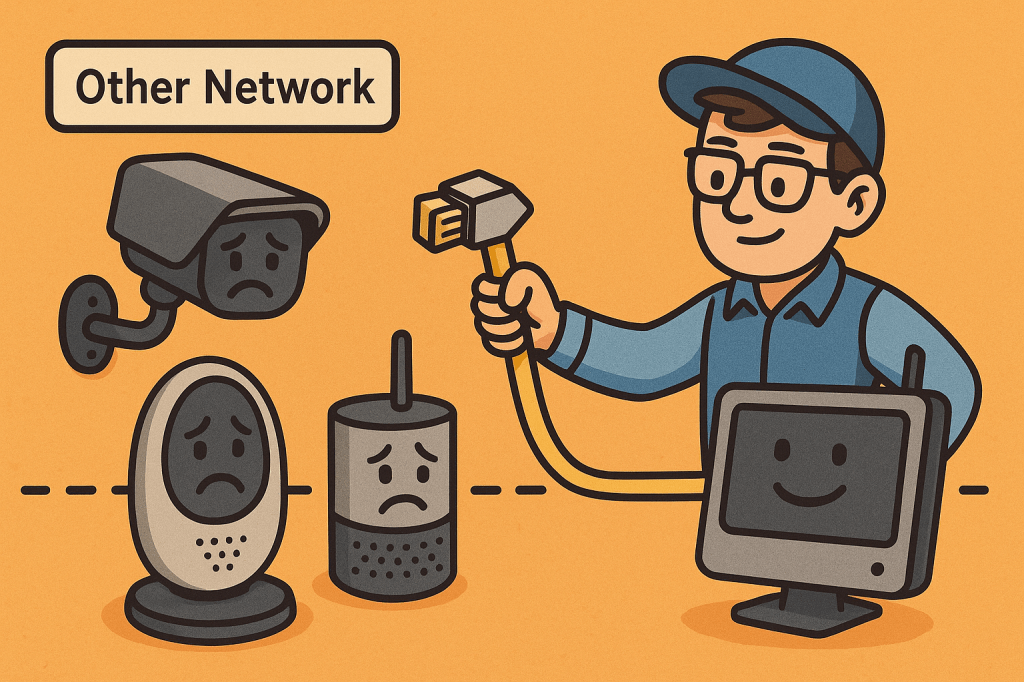
- Network Segmentation: Don’t let IoT devices sit on the same network as critical servers or workstations. Isolate them on separate VLANs or guest networks.
- Disable Unused Services: Turn off Telnet, SSH, or UPnP if they’re not needed. Fewer open doors means fewer opportunities for attackers.
- Traffic Monitoring: Keep an eye on outbound traffic. If a DVR suddenly starts talking to IPs in random countries, that’s a red flag.
How the Industry Responded
- No More Default Passwords: Many governments, including the UK and California (USA), introduced regulations banning devices from shipping with universal default credentials.
- Security by Design: Manufacturers are being pushed to bake security into products — unique credentials, forced password changes, and more robust update mechanisms.
- ISP-Level Protections: Internet service providers now play a bigger role, filtering abnormal DDoS traffic before it reaches the wider web.
- DDoS Mitigation Services: Content delivery networks (CDNs) and cloud providers like Cloudflare and Akamai strengthened their defenses, offering automated DDoS detection and scrubbing.
- Threat Intelligence Sharing: Security communities now collaborate faster, publishing indicators and signatures of Mirai variants almost as soon as they appear.
The Ongoing Battle
Even with stronger defenses and smarter practices, Mirai hasn’t disappeared. Its variants still circulate, feeding on the millions of insecure IoT devices that remain online. But the lessons it left behind have made defenders sharper, the industry stronger, and users more aware of the hidden risks in everyday devices.
Mirai began as a simple tool to dominate Minecraft servers, yet it grew into a global wake-up call. It proved that the internet is only as strong as its weakest device, and that convenience without security can quickly spiral into chaos. From webcams to routers, every “smart” gadget we connect has the potential to become a soldier in the wrong hands.
And yet, Mirai’s legacy is more than the damage it caused — it’s the roadmap it left behind. By studying its techniques, mapping them with frameworks like MITRE ATT&CK, and adapting our defenses, the cybersecurity world has grown stronger. The timeless lesson is clear: security cannot be an afterthought. If IoT and automation are to truly be a boon, they must be built on trust, not weakness.
 LahiriSec